AI was supposed to give us time back. Instead, it put us on a productivity treadmill
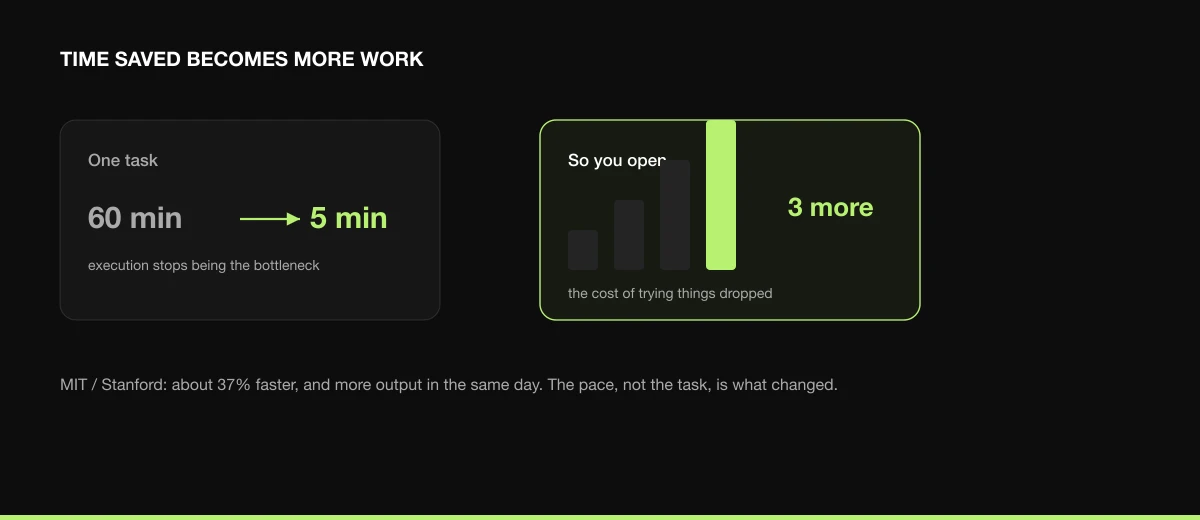
I finished a one-hour task in five minutes.
AI did most of the work. It summarized a meeting, structured the notes, and turned them into a clean document almost instantly. For a moment, I thought: great. That's nearly an hour of my life back.
But instead of closing my laptop earlier that day, something else happened. I opened another document. Then another. Then another.
By the end of the day, I hadn't saved time. I had simply fit more work into the same day.
That's when I realized something strange about AI. Automation doesn't just save time. It often changes the pace of everything around us.
The productivity treadmill
Think about a treadmill at the gym. You start walking at a comfortable pace. Then someone increases the speed slightly. You adjust. A few minutes later the speed increases again, and suddenly you're running.
Not because someone forced you to run, but because the pace changed around you.
AI tools like Claude, ChatGPT, and coding assistants are starting to feel like that treadmill. Tasks that once took hours can now take minutes. Writing, coding, researching, planning, even building prototypes have become dramatically faster.
But when friction disappears, something interesting happens. Instead of doing less work, we usually start asking a new question: what else can I do now?
Automation removes effort, but it often expands possibility.
When productivity becomes addictive
There's also a psychological effect that's easy to overlook. AI creates an incredibly satisfying feedback loop.
You type an idea, and seconds later something real appears: a draft, a structured plan, a piece of code, a new workflow. That kind of momentum feels powerful. It feels like progress.
And once you experience that speed, it becomes tempting to repeat it. You start thinking about other things you could automate, other ideas you could test, other projects you could explore.
One idea becomes three. One automation becomes ten. One project becomes several experiments running in parallel.
Not because someone demanded more work, but because the cost of trying things suddenly dropped.
The hidden cost: velocity
The challenge isn't the work itself. It's the velocity.
AI removes many execution bottlenecks, but it introduces something new: the need to orchestrate many systems and outputs at once. Instead of slowly completing one task at a time, we jump between reviewing AI responses, refining prompts, testing workflows, and switching between different contexts.
Suddenly we're not just doing work. We're managing streams of automated output.
While AI can process enormous amounts of information instantly, human brains still need time to absorb, evaluate, and think. When everything moves faster, that thinking time becomes harder to protect.
The result can feel like a new type of overwhelm, not from too much manual work, but from too much speed.
The competitive effect
There is also a broader dynamic happening across teams and industries. When someone starts using AI to complete tasks five times faster, expectations begin to shift.
What used to be considered a one-week task might suddenly become a one-day task. A one-day task might become something expected in a single afternoon.
This shift often doesn't come from pressure or explicit demands. It simply emerges as people realize what is now possible with the tools available to them.
As more people adopt AI, the baseline changes. The overall pace of work increases, and everyone adjusts to the new speed.
The surprising statistic
The acceleration isn't just a feeling. Research is starting to show it as well.
In a widely cited study by researchers from MIT and Stanford, professionals using generative AI tools completed writing-related tasks about 37% faster on average, while also producing work that was rated higher in quality.
In other words, AI didn't just help people work faster. It enabled them to produce more output within the same amount of time.
When that happens across entire teams and industries, something bigger changes than individual productivity. The expected rhythm of work itself begins to accelerate.
The real bottleneck: thinking
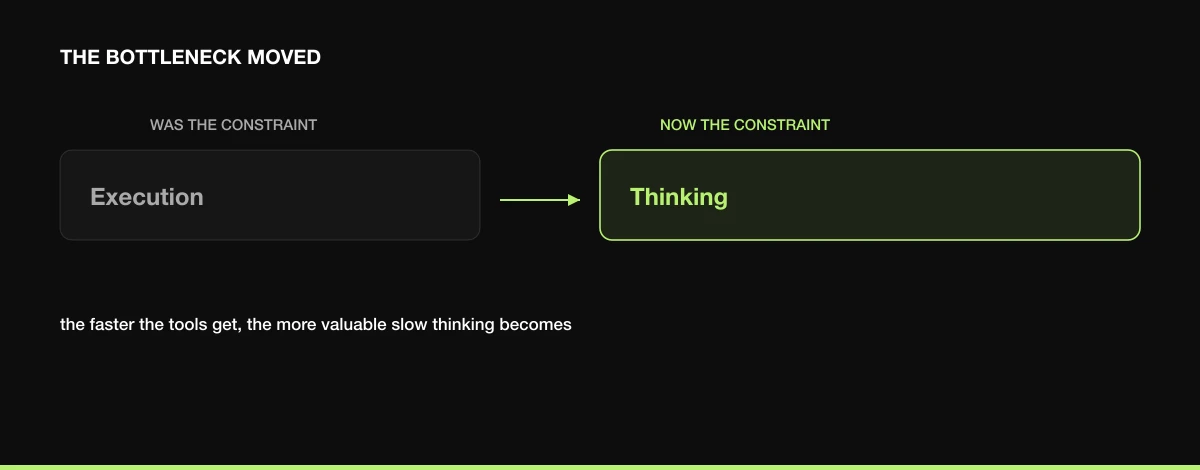
For years, execution was the main constraint in many kinds of work. Writing took time. Research took time. Building prototypes took time.
Now many of those steps can happen in seconds.
This reveals something interesting: execution may not have been the real bottleneck after all. Thinking might have been.
Good thinking still requires reflection, exploration, and the ability to sit with a problem long enough to understand it deeply. AI can generate answers instantly, but it cannot replace the human time required to interpret those answers and decide what truly matters.
Ironically, the faster our tools become, the more valuable slow thinking becomes.
A messy transition
In the long run, AI will likely give people more freedom. Automation can eliminate repetitive work and allow small teams to build things that once required entire organizations. It can unlock creativity and reduce many forms of friction in daily work.
But transitions are rarely smooth.
Right now we are living through a moment where capabilities are expanding rapidly, expectations are rising, and the pace of work is increasing at the same time. Humans are still adapting to what these tools make possible.
That adjustment period may feel chaotic. Many people may feel more overwhelmed before things start to stabilize.
Not because AI is failing, but because the world around us just became significantly faster.
The question I keep coming back to
AI might allow us to do more than ever before.
But the most important skill of the next decade may not be productivity. It may be the ability to decide when not to accelerate.
Because if every task becomes easier, the temptation will always be to add more. More ideas, more projects, more output.
The treadmill keeps moving.
So perhaps the real question is not whether AI will give us more free time. The real question might be whether we will actually allow ourselves to use that time once we have it.
First published on Medium.


 Miguel Vicente Jr

