Soon, talking to a human will cost extra
The first layer of AI isn't taking our jobs. It's quietly putting the humans behind a paywall, and I've already started paying.
My car had been at the repair shop for two days and nobody had told me anything. No call, no update, no message. Normally I'd let it go. But my wife was pregnant and could go into labour at any moment, and I needed one simple thing: to know whether I'd have a car when that happened.
So I called. The bot took my details, understood nothing, and said the line I now hear in my sleep: "I'll redirect you to an agent." Then the call dropped. I called again. Same script, same promise, same dead line. It hung up on me on the way to the human three times before I got through.
When a person finally picked up, she answered the question in about thirty seconds. The car was ready.
I wasn't angry at the bot. The bot was working exactly as designed. What stayed with me was something quieter. The human was the hard part to reach. The human was the upgrade I had to earn.
The first layer
The bots we argue with today are the first layer of AI that ordinary people actually touch.
Not the models in the research papers. Not the copilot inside someone's job. For most people, the first real contact with AI is a customer-service bot. Booking a table. Chasing a takeaway order. Checking into a hotel. Asking the garage if the car is ready.
It landed there for an obvious reason. Customer service is expensive, repetitive, and easy to measure. It's the first place a company puts a machine. So it's also the first place the public forms an opinion about what living next to AI actually feels like.
And right now, for a lot of people, it feels like being processed.
We have done this before
Here's the thing I keep coming back to. We already know this move. We've run it at least twice, and it worked both times.
Fast food standardized a meal. It took something that used to need a cook, a kitchen, and judgement, and turned it into a process any teenager could run, identically, in any city, for almost nothing. The burger didn't have to be good. It had to be the same, everywhere, cheap. That's how you feed a lot of people fast.
In the war, the Americans did it to the vehicle. The Willys Jeep was built so the parts were interchangeable and any soldier could drive it, fix it, and keep it moving without a specialist waiting nearby. The engineering wasn't the weapon. The sameness was.
That's what standardization does. It finds the part of a thing that needs a specific, skilled, present human, and it replaces that human with a repeatable process. It genuinely lowers the price. It genuinely widens the access. This is not a trick. It is real value, and it's why most of the comfortable world runs on it.
Customer service is now going through that same machine. The bot is the interchangeable part. Same script in every city, awake at 3am, almost free to run one more time. By the logic of the last hundred years, this is simply the next thing to standardize.
What standardization quietly does to the other option
Now the part we don't say out loud.
When you walk into a fast-food restaurant, you barely speak to anyone. That isn't a flaw in the experience. It is the experience, and it's exactly why the meal is cheap. But the moment you want someone to take your order, carry it to a table, and come back to ask if it was good, you leave. You go somewhere else, and you pay more.
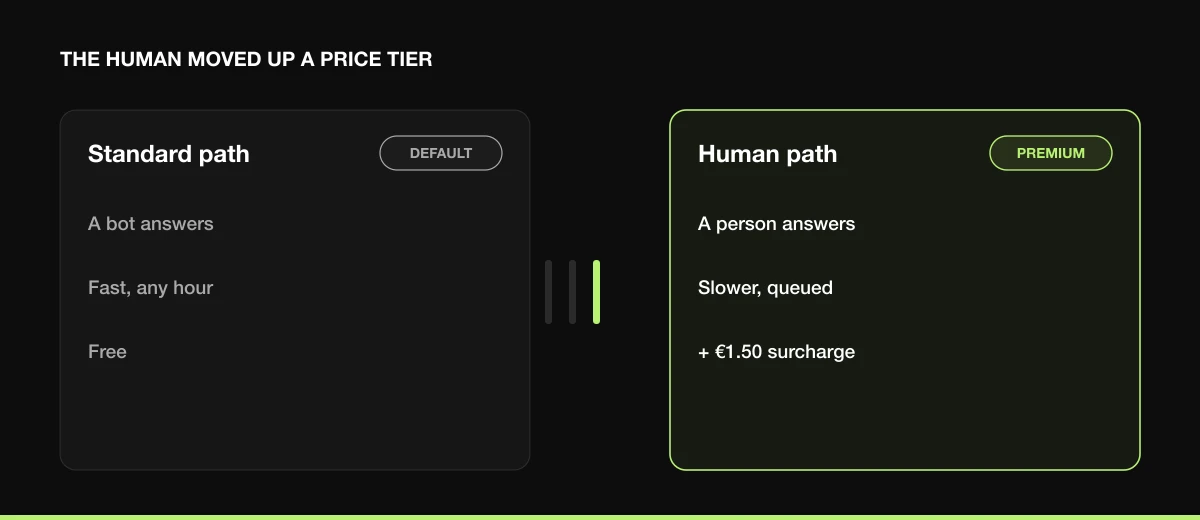
The human didn't disappear. The human moved up a price tier.
Watch it happen and you can't unsee it. Standardization doesn't just make the cheap version cheap. It quietly turns the un-automated version into the expensive one. The waiter. The concierge. The mechanic who calls you back. Each of them used to be normal. Each of them is becoming a feature you upgrade to.
I already paid to talk to a human, and it was about a pizza
This isn't a prediction. It's already happening, and the prices are small enough that nobody notices.
Last month I tried to change a pizza order. The app had defaulted to my home address, but I was at a neighbour's house and needed the driver to ring a different door. A trivial change. The kind of thing a person solves in one sentence.
The app wouldn't let me. To actually reach the shop and change the address, I had to pay an extra €1.50, and then wait another 45 minutes for them to update the order. One euro fifty to speak to a human about a pizza.
That's the whole future in one receipt. The standard path is automated, fast, and free. The human path exists, but it sits behind a surcharge and a delay. Nobody banned the human. They just put a turnstile in front of him.
So here is my prediction, and I think it's a small, hard-to-argue one.
Talking to a human is becoming a premium service.
Not because companies are cruel. Not because anyone decided humans don't matter. Simply because that is what standardization always does. It makes the version with a person in it the one that costs more.
The upgrade nobody priced
There will be brands built on exactly this. No bots. A person answers. A person remembers you. It'll be sold the way a tablecloth and a waiter are sold against a self-service counter, as the warmer, slower, more expensive choice. The "talk to a real human" tier. Possibly with a monthly fee.
Sit with how strange that is.
Social interaction is close to the most basic thing that makes us human. We have treated it as free and unlimited our entire lives. And we are about to start paying for it. Quietly, in subscription tiers and priority queues and €1.50 surcharges, without ever quite noticing the moment it stopped being free.
What people actually want
The uncomfortable detail for everyone betting fully on automation is that customers keep saying the opposite of what's being built.
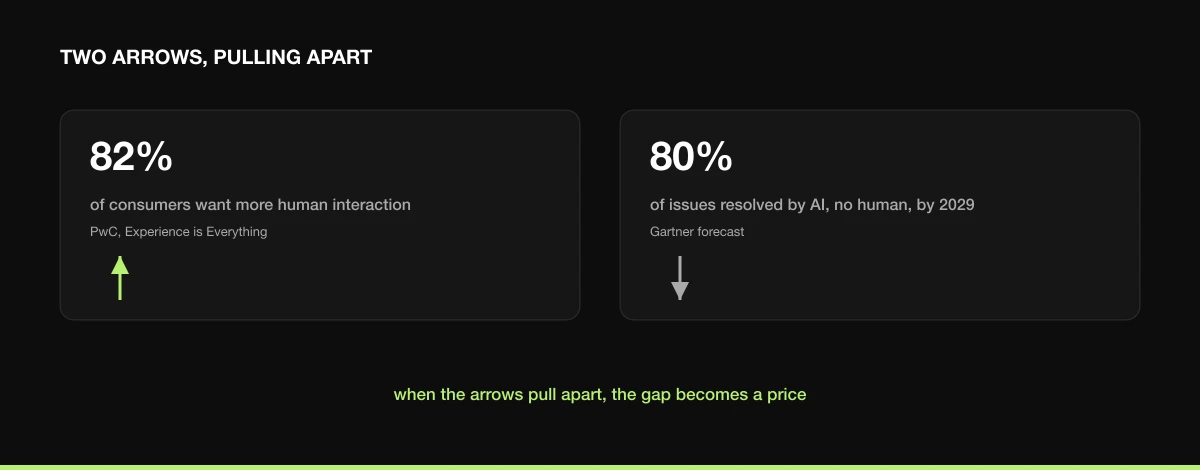
In PwC's Experience is Everything research, 82% of US consumers said they wanted more human interaction in the future, despite advancing technology. In the same study, 59% felt companies had already lost touch with the human element of service.
Now read that next to the industry's own forecast. Gartner expects agentic AI to autonomously resolve 80% of common customer-service issues by 2029, with no human involved.
Two arrows pointing in opposite directions. One drawn by the people paying for service. One drawn by the people paying for software. When those two arrows pull apart, the gap between them doesn't vanish. It becomes a price.
I'm not telling you nobody will have a job
I want to be clear about where I stand, because this kind of writing usually collapses into one of two lazy camps, and I'm in neither.
I don't think the human leaves the loop. Here's why. People are messy. My problem wasn't "track order 4471." It was a pregnant wife, a car I couldn't see, and two days of silence. The pizza wasn't "modify delivery." It was a different door, a neighbour, a driver who needed telling. Real life is full of small, specific situations that don't fit the dropdown.
Machines are rigid. Processes are rigid. When the situation falls outside the script, the rigid system doesn't bend, it breaks, and you feel it as a dropped call or a €1.50 surcharge. Someone still has to handle the mess. That someone is a person.
The companies are starting to admit it. Gartner now predicts that half of organizations will abandon their plans to cut customer-service headcount because of AI, and openly questions the assumption that AI is even cheaper than the humans it was meant to replace.
So I don't think these jobs vanish. Maybe you don't need as many people as before, and that part is real. But the people who stay don't disappear from the building. They move behind the turnstile. They become the thing you reach only after the bot fails, and increasingly, the thing you pay to reach at all.
The work survives. Access to it gets priced.
The question I keep coming back to
The bots are the first layer. They're cheap, they scale, and they are not going away. Nor should they, for the things they genuinely do well.
But the more completely we automate the human out of the exchange, the more valuable the few remaining humans become. We're building a world where the machine is the floor and the person is the ceiling.
So the question isn't whether AI can replace the conversation. It clearly can, right up until your life stops fitting the script.
The question is what it will cost us, later, to buy the conversation back, and whether we'll even remember that it used to be free.
First published on Medium.


 Miguel Vicente Jr

